Agentic memory
Learn how agentic memory works, when to use working or long-term memory, and how agent memory and document RAG work together.
Agentic memory lets an AI agent store, retrieve and revise information as it works. It keeps selected facts, past actions and procedures available across sessions and runs. The agent or application decides what to save and which parts to bring into the model’s context for the current request.
A memory is one claim an agent should find again: “deploys happen on Tuesdays”, “the
payments team owns the billing service”. Loom stores each claim as a row in
loom.memory, under a readable key, with who wrote it, when it was true, where it came
from and whether anyone vouched for it. This page covers the row, how a write is judged
against what is stored, and how rows change over time.
Retrieval and ranking covers how rows are found.
Working memory and long-term memory
The context window holds the input supplied to the model for one request. Working memory holds small pieces of task state, such as a cursor or the checks already completed. A replacement process can read the block again with the same identity and run ID. Long-term memory carries reusable information across runs. It can include facts, past events and procedures for recurring tasks. See memory types for how Loom stores each one.
For a support agent processing a return, put the order and completed checks in working memory. Save a reviewed refund rule as a short claim and link it to the source policy. A later session can retrieve the rule within its authorized namespace. When the policy changes, review the source and correct the saved claim so readers can see which version they used.
How agent memory and RAG work together
Retrieval-augmented generation (RAG) brings retrieved evidence into the model’s input before it generates an answer. Agent memory keeps selected facts, decisions and procedures available across runs. An agent can retrieve memories, documents, or both before it answers.
For a return, retrieve the current approved policy to find the refund window and cite the document revision. Retrieve a saved lesson to find how the team handled an earlier exception. Use the policy for the rule and the lesson as evidence about that case. If the lesson and the current policy disagree, check the cited passage and send the lesson for review before reusing it.
In Loom, document search returns passages and their source citations. Memory search retrieves saved claims. When a claim comes from a policy, link it to the source document so a later reader can verify the evidence.
How to tell whether an agent used a memory
Suppose the agent retrieves an earlier refund exception while processing a return. Check which evidence the agent applied to the current order.
- Check what the model received. Record the memory keys returned by search and compare them with the evidence your application passes to the model.
- Check what the agent relied on. Inspect the answer or action for the rule the
agent applied to the order. Run history
separates recalled keys from
memories_used, which records what the agent reports using. - Check the outcome. Grade the decision against the approved policy. To measure the effect of memory, compare runs with and without saved lessons using the same model, tools, policy revision, and acceptance criteria.
Rows in ClickHouse
Memories, document chunks, conversation turns, entity edges, code symbols, runs, audit
entries and erasure requests are all rows in ClickHouse, created by numbered migrations
the server applies on boot. Under the
Postgres memory authority,
Postgres holds live memory and knowledge state, and ClickHouse keeps the vectors, search
and history. Uploaded document originals are ClickHouse rows too
(loom.document_blobs), unless the deployment keeps their bytes in an S3-compatible
bucket. Outside ClickHouse, Postgres and that bucket, Loom keeps the code index’s git
mirrors, a cache of the remotes ClickHouse records, and the rate-limit buckets on a
shared volume.
- The identity tuple leads the sort keys.
loom.memoryis ordered by(org, namespace, agent, user_id, session_id, memory_key), so scoping a read to a namespace is a primary-key range; a user narrows it fully only under a named agent, a session only under a named agent and user. Identities and namespaces covers the tuple. - One engine. Under the default ClickHouse authority, vector search, lexical search,
the graph walk, filters, audit and erasure are SQL over the same rows, with no second
store to keep in step. The cost is that every read is a query, not a key-value hit.
Under the Postgres authority, point reads (by key or id, outside an
as_ofreplay) are answered from Postgres. - A write is a new version. The memory tables are
ReplacingMergeTree(version)read withFINAL. A revision, tombstone, pin or restore inserts a new version row.
The write, derive, read loop
- Write.
memory.setruns its checks (below), embeds the value inline, and inserts the memory row, its embedding row, verbatim chunks for long values and a hash-only audit row. If the inline embed fails, the call fails and nothing is written.memory.set_from_messageshas the LLM pick the durable facts in a transcript and writes through the same bulk path. - Derive. Workers add what is too slow for the write path: entity tags
(
entity_extractor), deferred extraction (extraction_queue), consolidated facts, gate recalibration, and usage folded into ranking signals (usage_fold). Derived rows carrysource_class=derived. - Read.
memory.searchruns several legs (vector, lexical, entity graph, verbatim chunks, session digests), fuses them, ranks, and returns hits or abstains.memory.askwrites a grounded answer;context.packbuilds a budgeted prompt block. - Feed back. A run that names the memories it relied on (
run.completememories_used, ormemory.outcome) credits them; a bad outcome records harm. This becomes a bounded, decaying ranking term. It never deletes a row or ranks it below its relevance.
The loop is eventually consistent. A read right after a write finds the fact through its inline embedding; entities and extracted facts arrive after the worker’s next pass.
The loom.memory row
One row is one version of one memory.
| Group | Columns | Decides |
|---|---|---|
| Identity | org, namespace, agent, user_id, session_id, run_id |
Who may read it and who wrote it |
| Address | memory_key, memory_id |
How a caller names it (key) and how Loom names one row (id) |
| Content | value, memory_type, tags, entities, files, confidence |
What it says and how it is classified |
| Lifecycle | status, pinned, conflict_with, duplicate_of, superseded_by, version |
Whether it is served, and what replaced it |
| Time | created_at, updated_at, valid_at, valid_to, invalid_at, expires_at |
When it was written, when it was true, when it left service |
| Provenance | actor, source_class, content_sha256, verified_by, verified_sha256 |
Who wrote it, how Loom learned it, whether anyone attested it |
| Guards | lock_mode, lock_until, sensitivity, on_expire |
Which writes it refuses and how it is read |
The full column list is in the schema reference. A searchable
memory also has a row in loom.memory_embeddings: vectors for the value and the key,
lowercased, stemmed and lemmatised copies of the excerpt for lexical matching, and the
source_class and verified flags the ranker reads.
Keys
A key names one attribute of one subject, as a readable path <scope>/<kind>/<id>:
sre/case/1234/evidence/dns-sidecar
project/loom/deploy-window
user/preferences/editor- One fact per key. Conflict checks, supersession and history work per key. A key holding a list of unrelated facts cannot be partly revised.
- A revision rewrites the same key. Loom keeps every version, so a numbered copy
(
…-v2) or a key made from a hash of the value only hides the revision. Hash-made keys are thehash_keysfinding ofnamespace.audit. - Facets go in
tagsandentities, not in the key.
The storage identity is (org, namespace, agent, user_id, session_id, memory_key): the
same key written by two agents or in two sessions is two rows. Under the namespace
policy newest_wins, the newest write for a key retires every older live row with that
key in the namespace, whoever wrote it. Extraction mints keys from the subject and
attribute, never from the value, so a later session that states the same attribute lands
on the same key. Under auto_reinforce and manual_review, the conflict resolver judges
the rows of one key that two sessions of the same user (not the anonymous user - or a
user_id sent empty, whose sessions are separate tasks) wrote, from a point write or a bulk
write, as it judges any close pair: it retires the older row of an update it is sure of
(except under manual_review), flags a contradiction for review and leaves two different
facts under a reused key live. Under append_only nothing is judged.
Memory types
memory_type is a free string, default semantic. A few values change how the row is
stored and found (server/memory/domain/memory_types.py):
| Type | Embedded | In unfiltered search | Use for |
|---|---|---|---|
semantic (default) |
yes | yes | Durable facts. |
preference |
yes | yes | Preferences that should rank in recall. |
procedural |
yes | yes | Procedures (procedure.*). |
reflection |
yes | no | Lessons from runs; read with memory_type="reflection". |
episodic |
no | no | Session events replayed by recency. |
profile |
no | no | Always-loaded context fetched by label (profile.*). |
any other (decision) |
yes | yes | Domain types are searchable by default. |
- Reflections are hidden from unfiltered search and
memory.ask: a lesson about a process is not a claim about the world. - A
proceduralwrite whose value is not a procedure body (a non-emptysituationand at least twosteps) is stored assemantic, taggedretyped_from:procedural, and the response says so inretyped_from. - Sensitivity. A row with
sensitivity="high"is never embedded, so no search leg finds it. It is readable by key only, and that read is audited. Withsensitivityunset the server detects credential shapes, card numbers, US Social Security numbers and stated PINs (high), and email, phone and IBAN shapes (medium) (LOOM_MEMORY_SENSITIVITY_AUTODETECT).
Status
| Status | Meaning | Served by default |
|---|---|---|
active |
The live belief. | yes |
conflicted |
Close to a peer but saying something different; linked by conflict_with. |
yes |
duplicate |
Near-identical to a canonical row (duplicate_of), which answers for it. |
no (include_duplicates) |
superseded |
A later row replaced it (superseded_by, retired at invalid_at). |
no (include_superseded) |
proposed |
A fact on trial, decided with memory.proposal_decide. |
no (include_proposed) |
rejected |
Marked wrong (memory.reject, or a rejected proposal). |
no |
tombstoned |
Deleted by its writer (memory.delete). |
no |
The served set is defined once, in server/memory/domain/temporal_sql.py (SERVED_STATUSES). A
conflicted row stays served: hiding one side of a contradiction would let the store
answer confidently with a fact it has reason to doubt.
How a write is judged
Five operations cover the memory lifecycle:
| Lens | Operation | Effect |
|---|---|---|
| Expand | memory.set |
Learn a fact under a key. |
| Revise | memory.update_by_id |
Correct one row by id (memory.update does the same by key). |
| Contract | memory.delete |
Tombstone a key and refuse later intake of its removed value. |
| Reinforce | memory.pin |
Store and pin: no later write that does not itself pin replaces it. |
| Refuse | blacklist.add |
Refuse every future write matching a substring or regex. |
A searchable memory.set runs these checks in order:
- Lock and pin guards on the row under the key.
memory.lock(read_onlyorno_delete) answers 423LOCKED. A changed value under a pinned key is 409PINNED_CONFLICT. A byte-identical restatement passes every guard. - Blacklist. A value matching a registered pattern is 422
BLACKLISTED; in a bulk write the entry is skipped. Replicas cache patterns and poll a one-row version table (loom.blacklist_version), so a new pattern reaches every replica within seconds. - Precondition.
if_match_sha256makes the write land only if the live row’s hash still matches; otherwise 409PRECONDITION_FAILED. The current hash rides everymemory.get,memory.get_by_idandmemory.setresponse (content_sha256). - Restatement. A value byte-identical to the live row writes a new version that
carries the live row’s
reinforcement_count + 1. The bulk path (memory.bulk_set, used byset_from_messages) treats any live row with the same hash in(org, namespace, agent, user_id)as the fact (LOOM_MEMORY_BULK_DEDUP_SCOPE=identity). - Peer search and verdict. Active rows of the same
memory_typewhose embedding is close to the new value are peers, compared closest first; a write that names itsuser_idtakes them from that user’s rows only (how a write is judged):- same canonical form (lowercased, punctuation stripped, whitespace collapsed) →
merge: nothing written, the peer is reinforced,merged_into_keynames it; - a close pinned peer →
rejected, 409PINNED_CONFLICT(under a namespace-wide token, a write that names its user and restates another user’s or a shared pinned value is written); - under
newest_wins, a peer that states the same subject and predicate with a different object →refines: the peer is retired, unless itsvalid_atis later than the new row’s, which answersconflict; - cosine at or above the duplicate threshold with the same content words and no
differing value (a number, time, amount or unit; “27:10” / “26:30”) →
duplicate; - cosine at or above the conflict threshold but different →
conflict, both rowsconflicted; - no close peer →
clear.
- same canonical form (lowercased, punctuation stripped, whitespace collapsed) →
- Insert into
loom.memoryandloom.memory_embeddings, supersession, entity projection and one hash-only row inloom.audit_log.
A non-searchable type or a high-sensitivity row skips the peer search: it has no
embedding to compare. dry_run=true runs every check and writes nothing, which answers
“new fact, restatement or contradiction?” before you commit to a key. The response
carries conflict_verdict, up to five peers, and a next hint.
- Thresholds. With
LOOM_ADAPTIVE_THRESHOLDSon and a real embedder, the conflict and duplicate thresholds come from the embedder’s own similarity distribution at boot (server/memory/app/embedder_calibration.py). The scalarsLOOM_CONFLICT_THRESHOLD(0.85) andLOOM_DUPLICATE_THRESHOLD(0.97) are the fallback. A namespace or memory type can pin its own;calibration.getreports which is in force. - The conflict resolver. Cosine says two statements are about the same thing, not
whether they agree. A leader-only worker judges each write with a close peer after it
lands, one LLM call per row: it retires the older row of an update it is sure of under
the default
auto_reinforceand undernewest_wins(the old value stays readable withinclude_supersededandas_of), flags a contradiction, and clears a false flag (conflicts). No verdict on the write itself calls an LLM. - Run scope. A write under a
run_idwhose canonical match belongs to another run is stored as aduplicate, not merged, so a run-scoped read still finds it. - Namespace policy.
default_conflict_policydecides what a contradiction does (auto_reinforce,manual_review,newest_wins,append_only).
memory.update, memory.update_by_id and memory.bulk_set run the same check. Verdict
details, the policies, the Review queue and conflicts.resolve are in
conflicts and refusal.
Pins protect what the user said. A pinned row is never replaced by a write that does
not itself pin, by key or by a close value under another key. To change it, use
memory.update (keeps the pin) or memory.pin (re-pins). memory.for_file lists
pinned rows first; no other read orders by the pin.
Consolidation keeps lineage. memory.consolidate (and the consolidation worker, when
a namespace opts in) merges fragments about one subject into canonical rows with
source_class='derived', and writes one loom.memory_belief_sources row per source
(support_type='derived_from'). Deleting a source retires a consolidated row when none
of its sources survive, and downgrades it to conflicted when some do
(dependents_tombstoned, dependents_downgraded in the memory.delete response).
A memory’s lifecycle
Every arrow is a new version; the old one stays in loom.memory_versions.
Tags, entities and files
tagsare free labels (case:1234,kind:evidence). A search filters on them (tags), boosts with them (tags_soft), or sinks them (demote_tags). A namespace’stag_registrycan attach retention, dedup and conflict policy to a tag. Tags keep the case they were written in:memory.listandknowledge.listmatch them in any case, and every other tag filter,memory.searchandmemory.applyincluded, matches them exactly.entitiesare the named things the value mentions, stored in the canonical form search reads them in (lowercased; articles, possessives and punctuation dropped; the head noun singular), soBilling Servicesandbilling serviceare one entity. A writer may pass them; otherwise theentity_extractorworker fills them. They drive the entity boost and the entity graph.filesare repository paths the memory is about;memory.for_fileserves them before an edit of those files.
memory.for_file renders one line per memory. A decision or a constraint prints whole,
up to the ceiling below, and does not count against the request’s token_budget (300
tokens by default); the other rows are held to it, cut to one line of 220 characters. A
row that does not fit is left out whole while the rows after it still get their turn,
and a closing - … <n> more line, which counts against the budget too, says how many
were left out and how to list them. The header and the removal footer are always
printed, and the … more line whenever a row is left out, so a budget smaller than those
can be exceeded.
Decisions and constraints share one ceiling, memory_for_file_whole_tokens (1,500
tokens, about 6,000 characters), so a file governed by dozens of them cannot flood the
prompt. They print in the block’s order; one that would pass the ceiling is left out,
and the ones after it that still fit print. A closing line counts those left out and
names the first five keys, each read with memory.get (in the namespace it names, for a
team row) or found with loom_search. A row left out with the newer row that supersedes
it is counted on the … more line instead, never named as one to read. The default
keeps the whole block under the 10,000 characters a coding-agent host passes from a hook
to the model as it is.
Each line:
- A memory from an extra namespace (the repository’s code namespace) is headed
Team rule (by <author>, <age>), orDecision (by <author>, <age>)for a decision (memory_typedecisionor the tagdecision). - A line lists its
constraint,gotchaanddecisionkinds in one bracket ([constraint, decision]; a line headedDecisionleaves outdecision). (pinned)marks a pinned row. A pin is the row’s own flag: a member of a code namespace can set it on a row they write there, so(pinned)on a team row says someone froze it, not that a maintainer did.- A decision nobody pinned, such as one
loom decisions extractwrote, carries no pin mark: it is served as it is. (outcome: failed)marks any decision whose recorded outcome failed, pinned or not.- A decision tagged
source-changed(its source document no longer says it; see extracting decisions) reads(source changed), pinned or not. - A note says when its linked code changed or went.
- A string value is printed as text, not as the JSON it is stored as, and a row other
than a decision or constraint ends in
…when the read or the line cut it; a cut object or list prints as stored. - A decision with a source carries
— source: <source_resource_id>after its value, whole, so aknowledge:citation keeps its#sectionand resolves throughknowledge.get. - A newer row the conflict check linked to an older one of its type is placed above it,
and a team line says which it supersedes (
supersedes decisionwhen the older is taggeddecision). Two typed decisions the check linked each keep their place in the block, with no such note, since each decision key is its own decision. When the budget or the ceiling leaves out any row that supersedes others, in any namespace, every row it supersedes is left out with it, so an older row never reads as current.
Memories linked to code
What this gives a coding agent, and where to start: memory linked to code.
A memory about code is linked to the definitions and files it names, and the links
follow the code. The memory_code_links worker links each memory tagged repo:<id>
(the coding plugins tag their sessions) or written in a repository’s code namespace
against that repository’s trunk:
- each backticked name,
A::banda.b()call that resolves to exactly one definition; the memory’sfilespick between namesakes, and a name defined more than once is not linked; - a bare camelCase or snake_case word of the prose only to a definition in the memory’s
files; - each file the memory names that holds none of those definitions.
The worker checks pending names in pages and links them when it finds their definitions
on trunk. It drops names older than memory_code_links_pending_days (14 by default),
measured when the scan starts.
A memory whose key starts with obs: is a raw tool observation (observe.record keys a
tool call’s row obs:<session_id>:<sha8>) and is never linked: it records a tool call, not
a lesson, though a coding plugin’s carries its session’s repo: tag and quotes the code a
tool read.
A link records the definition’s fingerprint: all its overloads and the conditions that
select them, as tokens, so whitespace, comments (not a Go //go: directive or a Python
# type: comment) and most of what formatters change (trailing commas and other optional
separators, a JavaScript ;, quote style and the escapes it needs, the case of a number
literal, a Python docstring’s indentation, parentheses in Python, JavaScript and
TypeScript) leave it as it was. Joining adjacent string literals, and any other edit, does
not.
What a file defines is read from the file at the repository’s indexed head in its bare
git mirror. On every indexed commit the worker follows the commit’s renames and edits, and
a code.refresh call
follows them as soon as its ingest pass ends:
| Link state | When |
|---|---|
fresh |
The definition is where it was, with the text the memory was written against. |
moved |
Its file moved, or it was renamed with nothing else changed, or it moved to another file. |
changed |
Its text changed after the memory was written (changed_since names the commit), renamed or not. |
unresolved |
Its name is gone and a new definition in its place may be it, but none certainly is. Served, with a review signal. |
missing |
The code is gone: nothing new took its place. The link keeps its place, so a revert finds it again. |
A link to a file follows the lines of that file that hold a name the memory cites: the
last part of each name above, of four or more characters, as a whole word. A name on
more than eight lines of the file (None, self) is a word of that file and is not
followed. The link reads changed when the cited lines are no longer the ones the memory
was written against, and fresh again once they are back. An edit to a line that holds
none of those names, a shift of the cited lines or a new indentation leaves it fresh,
so a memory about a long file is not marked by every commit to it, and a memory that
cites no name in the file (a rule about the file as a whole) is marked only when the file
moves or goes. An edit that takes a name across eight lines changes which lines are
followed, and marks the link. A link written against no cited line takes the first ones a
later commit brings as the lines it was written against. When a commit defines a name the
memory gives in the file (the memory was written before its function merged), a link to
that definition, written against its text at that commit, replaces the file link. A name
the memory already has a link for keeps that link: a commit never moves a link to a
namesake. revise does not re-check a file link: a changed one is flagged.
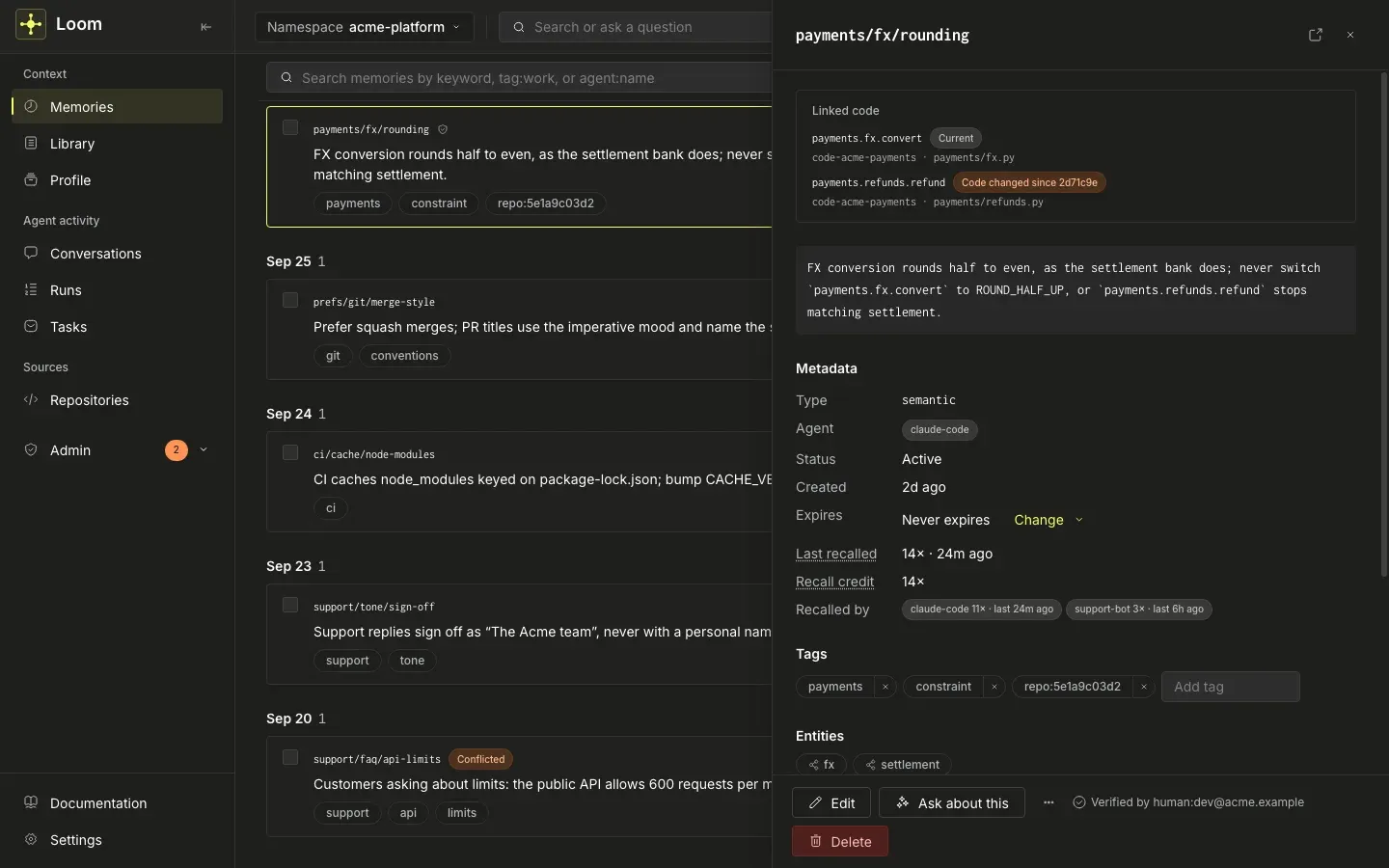
A memory’s detail in the dashboard lists these links with their state (clip).
A link follows its definition through file moves, renames (with an edit, when the new name is related to the old), and its class’s rename within the file. A definition renamed as it moves to another file, class or namespace is looked for among the definitions the changed files did not have before, by three rules in turn:
- The only one with its tokens under another name reads
moved. It is looked for before a definition of its own name with an edit in another file, and whatever the search of its own file left unsure. - The only one of its own name with a close text reads
changed, unless a definition of that name that stayed in the changed files is close as well. - The only one whose text is nearly its own under any name, a tenth of its tokens
differing at most (a parameter, a callee renamed with it), reads
changed, when no other removed definition is as near to that one and no definition that stayed is as near to it.
Rules 2 and 3 apply only when the search of its own file left no new definition there
that may be it. A member reads changed there unless its class came with it unchanged.
Two definitions that may be it, or one that another removed definition may have become,
leave the link unresolved. A definition under a name its file already had is another
definition: a copy that was already there never inherits a link, nor does one whose text
is only close to the lost one’s. The exception is a name that held another text and now
holds the tokens of a removed definition of 30 tokens or more: the commit put that
definition under a name the file already had (a class moved onto the name another class
gave up, a helper inlined into its only caller), and rule 1 follows it there.
A definition under 30 tokens is mostly its signature. It is told by its tokens only with
its name or its scope, and by its text under another name only token for token: its
tokens under a condition it did not have before read changed.
- From module level it goes, into any scope, under a name of the same words (
_read_rowsorread_rows_v2forread_rows), and to the module level of another file under a name that holds those words with more before or after them, or one those words hold (bulk_read_rowsorread_rows2forread_rows, andread_rowsfor either). A name of one word is held by any name about the same thing (ErrorbyReadError), so it counts only with a number after it (D2forD). - A member, whose name any class may define, goes only with its class, under a name related to its own. That class is the one renamed alone or with nearly its text, or the one keeping its members’ names, once no member of it is left in its file: at least half of them, or two when one more of its members, of 30 tokens or more, came with its tokens. Under its own name the member is one of those two, so that one larger member is then all that tells the class. Or it is the class that two more of its members, of 30 tokens or more each, left for with their tokens under their names.
A range that changed more than 32 files under the entry’s path_prefixes is not parsed
whole: the definition is looked for in the files that hold, at either end of the range,
one of its three longest lines without its name, by a search of the mirror. Only those
files and the link’s own are parsed, so a removed or kept definition in a file that holds
none of those lines contests nothing. That search is not made for a definition with no
such line of 12 characters or more, when those files are more than 32 with the link’s
own, when more than memory_code_links_mirror_changed_files changed (a warning in the
server log names the range), or when git cannot run or finish it, which is then not tried
again for the other links of that range in the pass; nor is a range searched whose diff
cannot be read. Over a range not searched a live link is read as if nothing was renamed.
An unresolved link is looked for from the commit its code was last read at, so its
range grows with every commit. While that range is within 32 files, the link is followed
once one definition that may be it is left. A wider range is read only where its lines
are, which cannot show that the definitions that left it unresolved are gone: the link
is followed when that read finds the one definition that is it, and stays unresolved
otherwise, as over a range that is not searched.
The memory_code_links worker’s pass outcome counts in wide_ranges the ranges past 32
files its own pass followed, not those a code.refresh call followed first. A missing
link comes back only when its own name does. A definition moved to another file under its
own name with an edit is followed there when its text is close to the one the link last
read. A new definition left where it was stops that search only when it may be the old
one under a new name: an export list or an unrelated function added beside it does not. A
name gone from its file is looked for in the files changed since its last check as the
mirror holds them, beside the index, so a definition moved by a commit the index has not
taken in whole (past code_ingest_max_files_per_commit) is followed when the link is
rechecked. When memory_code_links_mirror_naming_files or more of those files name it,
or more than memory_code_links_mirror_changed_files changed under the entry’s prefixes,
or the diff cannot be read, or the paths are more than git takes in one command or
searches in its time, the mirror adds nothing and the index decides. When git cannot run
the search, or a definition it finds cannot be fingerprinted, a live link the index’s
namesakes do not settle is unresolved. Files the ingest would not index (outside the
entry’s path_prefixes, refused by its denylist, over the byte cap, binary) add no
definition; a generated file, which the ingest declares without searching its text, does.
A file the parser fails on keeps its links as they were until it parses. When the
fingerprint rules change, every link is re-hashed from the commits its hashes were taken
at. When its old text is gone from git, a link that matched it takes the text the next
check finds and a changed one stays changed; one whose old text no longer parses keeps
its last state, and the worker reports it.
After a rename a memory’s text still says the old name until it is revised, by the
link pass where the swap is certain (below) or by a
person. Until then the reads that serve its links (listed below, namespace.validate
apart) name where the code is now. A link that is fresh, moved or changed at another path or symbol than
the memory was written against is served with both: the current path, symbol,
start_line and end_line (trunk’s, at the link’s last check), and was_path and
was_symbol, the oldest of the identities the link keeps (its last 16; a claim the
revise policy found to hold is re-anchored where the code is and still carries them).
A link to a file carries the path it was written against and no lines. A definition
renamed back to its first name carries neither, nor does an unresolved or missing
link, nor a link to a definition that replaced a link to its file. In text the line
reads
(code moved: `reader::fetch_rows` is now `reader::load_rows` at src/reader.py:12-40);
a line whose code also changed keeps its warning and adds the same clause. A line names
two such links and counts the rest. Naming the place moves no result: a moved memory
keeps its rank.
The namespace’s code_change_policy (namespace.register) decides what reads make of a
change:
| Policy | Removed code | Changed code |
|---|---|---|
retire_removed (default) |
When every link of a memory is missing (a pending or unresolved one counts as not), search (and memory.ask, context.pack) leaves it out before it picks its results; memory.get still shows it. It is back when the code is. |
Flagged. |
flag |
Flagged. | Flagged. |
revise |
As retire_removed. |
The claim is re-checked against the old and new code by the LLM: one that holds is re-anchored, a contradicted one gets a corrected claim as the link’s suggestion. |
Under every policy, a memory that a search still serves ranks lower when its worst link
is changed, unresolved or missing: it moves below the next
memory_search_code_changed_places (3) rows that rank by score (a row also moving down,
or already moved, is not counted), never out of the results nor below a row served only
as filler (under the similarity floor, or flagged below the abstain threshold), after the
confidence and abstain checks have read them in relevance order;
score_components.code_changed_places says how far among its own search’s rows
(loom_search places its merged repository decisions by similarity among the rows its
search did not rank down). These are never moved down:
- a memory a person holds;
- a memory whose only such links are into code the caller may not read, or are links
nothing keeps current (
memory_code_links_enabledoff); - a row placed by an identifier match or by an
anchor_firstorrecent_firsttier, which a move does not count as a place either; - every row a search serves for a query whose answer is a date order (
loom_search’s merged repository decisions, placed by similarity, still move); - the rows of a later page (
page=<handle>), served in their parked order; - a chunk, record or summary hit, which carries no
code_state.
A reader block (render="reader", loom_search’s block) whose question carries a time
word (when, after, since, latest, …) lists its rows by date, so the move does
not show in it; results keeps the move.
memory.ask re-sorts the search’s rows by similarity and recency while
memory_ask_recency_weight is above 0 (0.2 by default), and its identifier
lookups place their own rows; a context.pack startup read with no query does not
search: it lists pinned, then recent memories, leaves out a memory whose code is gone
under the namespace’s policy, and labels one whose code changed, was not found again or
went, as a search does. A move does not show in any of these.
revise judges a changed link once per edit, within a per-pass budget
(memory_code_links_revise_per_pass). A memory labelled high sensitivity is never sent
to the model. A memory a person pinned, locked (until the lock lapses) or verified, and
one naming more code than the link cap, is only flagged. Links made for an earlier value
of a memory (its text, files, repository or user) are ignored by every read until it is
relinked.
Links are kept against the trunk. On another branch, a lesson compares the branch’s own
definition, under any of the link’s last 16 names, with the text the memory was written
against: a release branch that still has the old text reads fresh after trunk changed
it, and one that has code trunk removed still gets its lesson. Where the branch’s files
cannot be read (a host with LOOM_GIT_HISTORY=none has no git mirror), a lesson carries
trunk’s last state.
The links are read where the code is:
code.symbolattaches the linked memories aslessons, each with itscode_stateand, when the definition read is at another path or symbol than the memory was written against,code_moved(on a branch, with the branch’s own lines; a branch that still has the code under an earlier name gets none, since the text names what it has). They come from the repository’s team namespace and thelesson_namespacesthe call names (over MCP the caller’s memory home when it names none), never from every namespace the caller can read. The read is bounded bycode_enrich_timeout_sand serves at most three; when it, or one matched member’s read, fails or runs past that bound, the definition carrieslessons_unread: true, so a caller can tell it apart from a symbol with none. The lessons it still carries may then be incomplete.code.search,code.callers,code.callees,code.impact,code.outlineand a task’scode.context_packattachlessonsfor the answer’s top files (code_result_lessons_paths): from the same namespaces, less any other repository’s code namespace, the memories linked to code in each file or naming it by its path or a tail of it (a bare filename,search/handler.py; an absolute path is trusted to name a file below the root that it ends in), each with itscode_state, withincode_result_lessons_tokens. Each row carriespath,memory_key,namespace,excerpt,code_state,rev(the first 12 characters of the commit its link was anchored at) for a linked row,first_written(the day it was first written) for a row with a code state,changed_since(the commit that put its code in a changed, unresolved or missing state) when one is known, andsupersedes_keywhen it replaces an older row, andcode_moved(its links to code in the file that is now at another path or symbol than it was written against) when there are any; a row another row read for the answer supersedes is not served.lessons_left_outcounts the rows the cap, a cut or that rule left out. A decision or constraint is served whole or left out. The read runs after the answer, never enters the search memo, and is skipped forinclude_lessons: false, withcode_result_lessonsoff, or for a token narrowed to its own user or session.code.grepin matches mode focuses inline lessons on the definitions its matches name in trunk files. When selecting files to read, grep prefers files with a current lesson linked to a matched definition at the returned revision.code.searchfocuses a file’s lessons when a returned definition has a complete linked lesson. They count omitted lessons inlessons_left_out. Grep keeps lessons when the matches and links cannot be checked at the same revision. A line with no enclosing definition also keeps lessons with overlapping or unverified ranges. File-wide notes, pending or uncertain links, nested definitions, decisions, constraints and pins remain eligible. Whole-file search hits, an unavailable live link check, or a configured lesson budget use file-level selection. Usememory.for_fileto read the broader file history.memory.for_fileserves memories linked to code in the file beside those whosefilesname it. A line whose code changed, was not found again or went says so and names the first indexed commit at which it read so, and a line whose code is now at another path or symbol says where (each hit lists those links ascode_moved);context.packdecision lines carry the same note, and its memory lines acode_state=<state>label (<state>@<commit>when a commit put it there) with(code moved: …)ahead of the text.memory.getreturns the links ascode(each with its lines, anysuggestion, andwas_pathandwas_symbolwhen the code moved);memory.searchhits read from a memory’s own row carry its worst link ascode_stateand, when that ischanged,unresolvedormissing, the commit that put it there, when one is known, ascode_changed_since, and the links now at another path or symbol ascode_moved(a chunk, record or summary hit carries none of these and is never left out). Arender="reader"block and every page ofloom_search’s text say so on such a hit’s line, with the same note as amemory.for_fileline. Where the deployment setsmemory_ask_code_namespaceto a code namespace the caller may read and leavesmemory_ask_code_stalenesson,memory.askgives its synthesis a note of the memories whose code moved, changed or went, with the same clause for a link now at another path or symbol.- Each of those reads says of a memory that names code which state it is in, the commit
its link was anchored at (
code_revon a search hit,revon a line or a lesson) and a day, under a label that says which day it is.first_writtenis the day of the memory’s first write: amemory.for_fileline, a lesson (the fieldfirst_written) and a startup recall line print it, and no later write moves it.writtenis the day the text served was written: a line of a search hit prints it from the hit’screated_at, the search document’s, which a write of the text (memory.set,memory.update_by_id) andmemory.restorestamp again. For a memory whose text was written again or restored,writtenis therefore a later day thanfirst_written. Neither is the row’supdated_at: an unpin, a lock, an unlock or a label moves neither. The commit is the repository’s indexed head when the link was made or last re-anchored; for a link made after its memory that is a later commit than the writer worked at. A search hit read from a memory’s own row that shows no link state, and whose text names a file by a path with a directory, isunlinked: the read has no comparison with code to show for it. Where no repository is indexed that is every such hit, and a hit whose only link is pending or in a repository the caller may not read is marked the same way. Amemory.for_fileline and a lesson are marked likewise; a memory that names its file only infiles, by a bare file name or by a symbol is not.unlinkedis a label a read gives: no row and no parked search page stores it. A reply that serves a memory with a code state says once what was compared: no code for anunlinkedmemory, and for every other state the repository as Loom indexed it, which is not the caller’s checkout. That sentence iscode_noteonmemory.search, the first line of a reader block, of acontext.packblock and ofloom_search’s plain lines, the line after the header of amemory.for_fileblock, and thenoteof a review brief’srationalesection, whose rows carry thememory.for_fileline. A block takes the sentence’s room from the budget of the row that prints with it, so a row left out takes its part of the sentence with it. namespace.validatelists memories whose code changed, was not found again or is gone, in the repositories the caller may read, and the edits that bring a memory’s text up to a rename its link followed.
A memory with no link carries no link state: a read marks it unlinked when its text
names a file by its path, and serves it without a label otherwise. namespace.validate
counts the served memories that name code (a backticked or qualified name, a call, or
files) and hold no link, by cause, as info findings:
| Check | The memory |
|---|---|
code_unlinked_no_repository |
names no repository Loom indexes that the caller may read: no repo:<id> tag of one, and not written in a code namespace. It is never linked. |
code_unlinked_file_not_indexed |
lists files, none of which is a path on the indexed trunk (not merged yet, outside the index, or a bare filename two files share), and no name in it is one definition. |
code_unlinked_name_unresolved |
lists no files, and each name is defined nowhere on trunk or more than once. |
code_unlinked_pending |
waits for its link; each sample says what it waits_for: link_pass (the worker has not read this write), index (no index yet, or a file that does not parse) or trunk (a qualified name trunk does not define yet). |
The counts are of the 2,000 served memories last written (of those under keys when
given), and only in an org that indexes a repository; a raw tool observation, which is
never linked, is not counted. How far each repository’s links trail its
index is a gauge, and a health warning when it lasts
(monitoring).
A memory’s text after a rename
A moved link is at its code, and the memory’s text may still name the old definition or
path. The link pass that follows the rename plans the edits that bring the text up to it
and applies them itself when all of these hold:
- the plan offers edits: none of the reasons in the table below applies;
- the memory is held in the repository’s code namespace, as a team rule or decision
is. A memory of any other namespace is linked through its
repo:tag, which its writer set and which grants nothing: its readers may hold no role on the repository, so the new name or path is not written into it; - no person holds the memory (pinned, locked or verified), and no service account attested the text as it is, which a revision would leave stale;
- the memory is
activeand not labelledhigh. One flaggedconflictedkeeps its text: a revision would drop the flag on its side while the other memory keeps its own; - the repository is indexed on one branch. Another indexed branch may still define the old name, and a memory linked again from its revised text is no longer served there;
- the org’s model calls are not switched off. The revision embeds the new text, so the pass revises nothing in such an org and takes its memories up once the calls are back on.
The revision is one memory.update_by_id write on the hash of the text the edits were
planned for, so a memory rewritten in the meantime is left alone. The write reads the
memory again under its key’s lock, and one pinned, verified, attested or no longer
active since the pass read it keeps its text. It runs that write’s
blacklist and conflict checks, embeds the new text and closes the facts the old value
stated, as any revision does. Nobody asked for it, so it changes that memory alone. It is
not written where a caller’s revision would do more: the conflict check finds the revised
text a duplicate, a restatement, a refinement or a contradiction of another memory, or
the conflict resolver would judge it against one. It also retires no other row of the
same key. Such a memory keeps its text and is listed with its edits.
The new version stays its writer’s row (actor is kept) and leaves an audit row by
process:code_rename and a memory.revised event; memory.history keeps the text it
replaced. Its source_class is never raised. A row its writer asserted is derived from
then on, since the text is no longer what they stated, so search no longer prefers it in
a near-tie (memory_search_asserted_boost_scale). Every other class is kept: an
unattested external row stays out of memory.ask synthesis. The next pass
links the revised memory where the code is, and it reads fresh. The memory_code_links
pass outcome counts the memories revised as renamed. A link followed with an edit to
its code reads changed and its memory’s text is never revised: whether the claim still
holds is the revise policy’s question. A recheck made inside a code.refresh call
revises nothing and leaves the memory to the worker’s next pass.
Every other memory keeps its text. namespace.validate lists each memory whose text
still names an old definition or path under the info finding code_rename_edits,
with either the edits its text allows (replace old with new from start to end,
counted in Unicode code points of the text, where the text reads old) and the
content_sha256 they are of, or the one reason no edit is offered. The finding’s
totals count the memories by edits and by reason. A memory listed with edits is one
the link pass left (held outside the repository’s code namespace, held by a person,
attested, flagged conflicted, in a repository indexed on more than one branch, or
close to another memory once revised) or has not reached yet. The
pass decides once, when its link follows the rename: a memory it left then is not
revised later, and neither is one whose link already read moved under a build that
revises no text (rule 67). Those stay
listed until a principal applies the edit. The report writes nothing: to apply an edit,
read the sentence it changes, then call memory.update on the key with the revised text and
if_match_sha256 set to the listed hash. That is a revision by the caller, with its
conflict check, and it is refused when the memory changed after the report read it. The
link pass then links the revised memory where the code is.
An edit is offered only for a name written as code (a whole backticked identifier, an
A::b, or a call written a.b( or name()) and for a whole repository path, in the
spelling the text uses: Reader.get becomes Reader.fetch, a full dotted name becomes the
full new one, and self.get keeps its receiver. The whole memory gets no edit for the
first of these reasons that applies:
| Reason | The memory |
|---|---|
not_text |
has a value that is not one string. |
link_not_settled |
has a link that is pending, changed, unresolved or missing, that its renamed class carried, or that is hashed under older fingerprint rules. |
incomplete |
names more code than the link caps keep. |
overloaded |
is linked to a definition the index numbers among several of one name. |
quoted_or_literal |
holds the old name or path in a fenced block, a URL, a quoted string or a backticked span that is more than one name. |
prose_occurrence |
writes the old name as a bare word of the prose. |
old_name_remains |
would still hold the old name or path where no edit reaches: a plain word, a part of a longer name, a longer name written as code that names no definition on the indexed trunk (conn.read_rows()), the dotted module the definition left (two segments or more) outside a name written as code that names a definition on the indexed trunk, a path before a line number, or a path whose file still exists. |
names_several |
writes one name that two of its links were written against. |
receiver_form |
writes the name as self.name, cls.name or this.name, and its files do not name the defining file. |
old_name_still_defined |
spells the old name in a way that still names a definition on the indexed trunk. |
new_name_present |
already holds the new name or path. |
dated_claim |
is dated (valid_to, invalid_at or temporal_anchor), or the sentence to edit holds a commit hash, a version tag, a year, a month (May only capitalised after another word), or a pull request or issue number. |
about_naming |
would be edited in a sentence about the name or the place: it holds name, names, named, naming, a word that starts with renam or alias, called, formerly, used to, replaced, moved from, deprecated, legacy, before or previously. |
named_in_key_or_tags |
holds the old name or path in its memory_key or a tag. |
named_in_files |
lists the old path in files, which memory.update keeps. |
would_unlink |
would lose a link once revised: the new name is not one definition on the indexed trunk, or the revised text no longer names a definition or file it is linked to. |
A memory whose text names no old name or path is not listed, whatever its links, key, tags
and files say: its bare name still holds after a move, or the link is back where the text
says. A sentence ends after ., ! or ? and a space (not after a one-letter abbreviation
such as e.g.), at a blank line and before a list item; a line break alone does not end
one. The words that mark a sentence as
being about the name are English, and call or calls is not one: it is read as calling
the code. The finding reads the 2,000 memories whose moved link was last checked (of
those under keys when given), in the repositories the caller may read, and no
high-sensitivity memory; a link whose code also changed is listed under code_links_stale. Neither the
memory’s key, tags, files, entities and concepts nor a line number written in its text
is edited.
Time
| Column | Axis | Meaning |
|---|---|---|
valid_at |
world | When the fact became true, as the writer stated it. NULL = unknown. |
valid_to |
world | When the fact stopped being true. A read drops a row past its valid_to. |
temporal_anchor |
world | The date the fact is about (an event date), set by extraction. |
created_at |
record | When Loom wrote the row. |
invalid_at |
record | When Loom retired the row (supersession). |
tombstoned_at |
record | When the writer deleted it. |
expires_at |
record | When the row leaves the served set, if its writer or the namespace owner set an expiry. |
An as_of read replays one axis. as_of_basis="valid_time" (the default) asks what was
true at T: rows whose best world date (valid_at, else temporal_anchor, else
created_at) is at or before T. as_of_basis="knowledge_time" asks what Loom had
learned by T: rows written by T and not retired, deleted or invalidated by T.
Under newest_wins, a templated substitution retires the peer only if the peer’s
valid_at is not later than the new row’s, so a backfill of old facts does not retire
current ones. This is valid time plus a retirement stamp, not a bi-temporal model:
supersession, not exclusion by date, decides which of two rows is current. A full
interval model would need every writer to state when each fact ended, which agents
rarely know.
Versions and history
Every change (value edit, tombstone, restore, lock, status flip) is a new row with a
higher nanosecond version and every other column carried forward. Merges drop old
versions, so loom.memory is the current state, not a history.
The history is loom.memory_versions, an append-only mirror filled by a materialized
view on every insert. memory.history reads every version of a key;
namespace.rollback returns every head in a namespace to its version at a point in time;
memory.redact scrubs a historical value and keeps its audit entry. content_sha256 on
each version is what if_match_sha256 compares and what an attestation binds to.
Provenance
The server stamps two columns on every write and never takes them from the body:
actor:human:<subject>orprocess:<subject>(a service account), from the token.source_class: how Loom came to hold the content, from the operation and the token.
source_class |
Means |
|---|---|
asserted |
A caller stated it directly (memory.set). |
extracted |
The extraction pipeline inferred it from a transcript. |
observed |
Loom recorded it from activity it saw. |
derived |
Computed from other memories (consolidation output, session digests). |
imported |
Loaded from another system by an importer. |
external |
Declared by the writer as outside content: a tool result, a page, a document. |
A request may only declare a downgrade (derived, external or imported); anything
else is a 422. Text an agent copies from its environment is what an attacker controls,
so memory.ask keeps unattested external rows out of its synthesis
(LOOM_MEMORY_ASK_EXCLUDE_UNVERIFIED_EXTERNAL, default on), and
LOOM_MEMORY_SEARCH_TRUST_WEIGHT can lift asserted and attested rows in ranking.
- Lineage. Consolidation writes
loom.memory_belief_sourcesrows; a session digest lists the keys it summarised insession_summaries.derived_from.memory.provenancesays where a row came from,memory.evidencereturns the conversation turns an extracted fact was drawn from, andmemory.lineagewalks how a shared memory was promoted. - Attestation.
memory.verifyrecords who vouched for the content, bound to its hash. Reads reportverification:humanorprocesswhile the content is unchanged,staleonce it changes,noneif never attested. An edit keeps the attestation and reads asstale; it never transfers trust to new content.
What goes where
| It is… | Plane | Why not memory |
|---|---|---|
| A fact still true next week that another session needs | Durable memory, memory.set |
It is memory. |
| A transcript the user wants remembered | memory.set_from_messages (extraction) |
One large row is findable only as a whole; extraction writes one short fact per key. |
| The current plan, a lease, a cursor, “where was I” | Working memory, working_memory.* |
Coordination state changes every step; ranking it pollutes recall. |
| A large tool result you may re-read | context.offload / context.fetch |
It is a blob to fetch by key, not a claim to rank. |
| The resumable state of one line of work | Session briefs, session.brief_* |
A brief is restored by choice, never ranked into another task’s answer. |
| A document, spec or runbook; anything over a few kilobytes | Knowledge, knowledge.add / knowledge.upsert |
Documents are chunked by heading; a memory is embedded from an excerpt of at most 1,200 characters. |
| A chat turn log | Conversations, conversation.* |
Turns are evidence, not beliefs; memory.recall reads the turns an extraction used. |
| Data with identity and exact fields (a PR, a ticket) | Records, memory.record.* |
Records fold field by field and filter exactly. |
| Always-loaded persona or preferences | Profile, profile.* |
Fetched by label every time; ranking it against questions wastes the slot. |
For documents: store the document in knowledge and write one short memory under a
readable key that says what it is and points at it. context.pack loads working memory
ahead of the durable sections, so an agent sees its own state first.
Retention
Loom deletes only what its writer asked for. No memory table has a default TTL and no
sweep retires rows by age. A row leaves the served set when its writer deletes or
supersedes it, when its writer gave it an expiry (ttl_seconds, valid_to), or when the
namespace owner or operator configured a retention window. memory.restore reverses an automatic
tombstone within 14 days when no permanent refusal exists.
Retention and erasure covers the settings
and the erasure saga.
One fact over time
In March a user says “I live in Delhi”; in June, “I moved to Berlin.”
- June write. Extraction mints the key from the subject and attribute, so both
statements land on the same key. The June row does not overwrite March: the Delhi
version stays in
loom.memory_versions, readable withmemory.history. - A misfiled fact. If Berlin lands under another key, the peer search finds the
Delhi row close but different and marks both
conflicted, linked byconflict_with. The namespace policy decides what follows (see how a write is judged). - “Where did they live in April?” An
as_ofread answers it, by when the fact was true or by what Loom knew at that date (time). - “Who said so?”
actorandsource_classrecord the writer and how the fact arrived;memory.evidencereturns the turns an extracted fact came from. - A bad import.
namespace.rollbackreturns every head in the namespace to its version at a point in time, and runs as a dry run unless told otherwise.
Example
Write a fact, probe a change before writing it, then update against the hash you read:
import asyncio
import os
from datetime import datetime, timezone

from loom import Datapack


async def main() -> None:
    dp = Datapack(
        org="acme",
        namespace="eng-tooling",
        base_url=os.environ["LOOM_BASE_URL"],
        api_key=os.environ["LOOM_API_KEY"],
    )
    agent = dp.agent("release-bot")
    key = "project/billing/deploy-window"

    out = await agent.memory.set(
        memory_key=key,
        value="Billing deploys only on Tuesdays and Thursdays, never on Fridays.",
        tags=["kind:constraint", "service:billing"],
        entities=["billing"],
        valid_at=datetime.now(timezone.utc),
    )
    print(out["conflict_verdict"], out["content_sha256"])

    probe = await agent.memory.set(
        memory_key="project/billing/deploy-days",
        value="Billing deploys only on Thursdays.",
        dry_run=True,
    )
    if probe["conflict_verdict"] == "conflict":
        peer = probe["peers"][0]  # closest peer, with its key
        current = await agent.memory.get(memory_key=peer["memory_key"])
        await agent.memory.update(
            memory_key=peer["memory_key"],
            value="Billing deploys only on Thursdays.",
            if_match_sha256=current["content_sha256"],
        )


asyncio.run(main())
A 409 PRECONDITION_FAILED on the update means another writer changed the row after the
read: read again and decide again. Over HTTP the write is POST /v1/memory.set; over MCP
it is the loom_memory_set tool.